Friday, March 28, 2014

Access and Equity in Mathematics Education - Where's the Technology?

This week I received the following email. I want to share it with the CLIME community. Please read and comment. Mine is the first one.
Ihor Charischak

NCTM At-Large Affiliate Presidents:
Over the past two years, NCTM has been working to revise its position statement on equity.  As part of this process, it was suggested that each of you be invited to review and comment on the statement from the perspective of your organization.  The attached statement reflects the work of NCTM Board members and some discussions among the Board.  You are invited to submit your comments for the consideration of the authors and the NCTM Board.  We would appreciate your comments by April 3.

Kind regards,
Ken Krehbiel
Associate Executive Director for Communications
National Council of Teachers of Mathematics

Access and Equity in Mathematics Education
A Position of the National Council of Teachers of Mathematics
(Note: Work in Progress - not final version - for review only)

Question
What does creating, supporting and sustaining a culture of access and equity in the teaching and learning of mathematics require?

NCTM Position
Creating, supporting, and sustaining a culture of access and equity requires being responsive to students’ backgrounds, experiences and knowledge when designing, implementing, and assessing the effectiveness of a mathematics program. Acknowledging and addressing factors that contribute to differential outcomes among groups of students is critical to ensuring that all students routinely have opportunities to experience high-quality mathematics instruction, learn challenging mathematics content, and receive the support necessary to be successful. Addressing equity and access includes both ensuring that all students attain mathematics proficiency and increasing the numbers of students from all racial, ethnic, gender, and socioeconomic groups who attain the highest levels of mathematics achievement.

The practices of access and equity include, but are not limited to, high expectations, access to high-quality mathematics curriculum and instruction, adequate time for students to learn, appropriate emphasis on differentiated processes that broaden students’ productive engagement with mathematics, and the strategic use of human and material resources. When access and equity have been addressed well, student outcomes—including achievement on a range of mathematics assessments, disposition toward mathematics, and persistence in the mathematics pipeline—cannot be predicted by students’ racial, ethnic, linguistic, gender, and socioeconomic backgrounds.

Achieving equity with respect to student learning outcomes by closing existing learning gaps and increasing opportunities to learn requires that educators at all levels operate with belief that all students can learn, focus on ensuring that all students have access to high-quality instruction, challenging curriculum, exciting extracurricular opportunities and the differentiated supports and enrichment opportunities necessary to support student success at continually increasing levels.

To provide access and equity requires all stakeholders to monitor the extent to which all students have access to challenging mathematics curriculum taught by skilled and effective teachers who differentiate instruction as needed, monitor student progress and make needed accommodations, and offer remediation or additional challenges when appropriate.  To do this effectively, teachers must work collaboratively with others educators, including special education, gifted education, and ELL teachers, to ensure that all students have the support needed to maximize their success in the mathematics classroom. In addition, teachers need to collaborate with colleagues to implement the effective teaching practices to promote a growth mindset in their classrooms and school.


Districts and schools must review policies to ensure that systemic practices are not disadvantaging a particular group of students based on assumed stereotypes. This should include a review of the use and impact of tracking, protocols for student placement in mathematics, regular opportunities for both remediation and enrichment, and student outcomes, including persistence within the PreK-12 mathematics pipeline over time. 

Friday, March 7, 2014

Two Activites to Help You Spring Forward

This is Spring?
Yesterday while returning from a Vet appointment, I passed a church that had a sign out front saying “Pray for spring.” I was reminded of that this morning as I looked out on my backyard (see pic) and noticed that the prayer wasn’t answered yet. Despite that, there are a few hopeful signs. I spotted a robin this morning forging for food with the rest of the hardy year rounders that are always taking advantage of my generosity with bird seed. The other sign is that today is March 7th and the spring equinox is only two weeks away. That means that students will be going out soon to measure shadow angles for the Noon Day Project. This year is special because my local math group AMTNJ is celebrating their 100th anniversary and the Eratosthenes measurement of the earth project is their highlighted activity. If you haven’t ever participated in the project do yourself a favor and watch Carl Sagan tell the story of how Eratosthenes measured the circumference of the earth to high accuracy using only sticks, shadows, a measuring device and brains!

The other event that reminds me that Spring is around the corner is March 14 better known as Pi Day.  See my post from last year entitled “A Pi Day Mystery”. Another possible treat for you is that I discovered the website teachpi.org put together by Luke Anderson. He’s the author of the Pi Rap that you will find there. His story is well worth a read!

And then of course there is Vi Hart now with Khan Academy. Check out her controversial(?) video pi is (still) wrong!

You might also have some fun with this headline Mathematicians stunned when Computer reaches last digit of Pi and Dan Cohen's TED talk entitled The Last Digit of Pi
Happy Spring Equinox and Pi Day. Can't wait.

Sunday, January 26, 2014

Flipped Classroom: A minor tinkering or a paradigm shifter?

Borrowed from Eric Sheninger's blogpost
I was pleasantly surprised that there were eight sessions devoted to the idea of the flipped classroom on the program for NCTM’s Conference in New Orleans. Usually the flipped approach is to assign a video for homework to the set the stage for the classroom lesson to follow the next day. Of course, there is no guarantee that the “teaching” will be any different using this novel approach. There are plenty of canned videos that may or may not be “better” than what would occur in a the classroom. I like the idea because technology is used in a potentially effective way. But will  it change the paradigm from teacher-centered classrooms to student-centered ones? These sessions should help you answer that question.

I've listed the 8 sessions below that I'm flipped about. If you attend (or are giving) any of these sessions, please let me know how it was (or will be) either with a comment below or email me at ihor@clime.org

66- Flip It Good! Creating an Interactive Flipped Math Experience
In this session, learn how teachers can use educational web pages and interactive iPad apps to turn the traditional flipped classroom model into an interactive social community engaged in process-based, collaborative math instruction.
Thursday, April 10, 2014: 9:30 AM-10:30 AM
223 (Convention Center)

95- Flipping Out about Math
This presentation will introduce or expand your knowledge of the trending instructional strategy called “flipping the classroom.” Participants will see how a flipped math classroom is conducted, become familiar with the technology and tools needed to effectively implement this strategy, and discuss results and challenges that may occur.
Thursday, April 10, 2014: 9:45 AM-11:00 AM
Grand Ballroom B (Hilton)

121- Ratio and Proportion: A Common Core Progression for Grades 6–7
This session presents a two-year, flipped sixth- and seventh-grade ratio and proportion unit using instructional videos viewed at home and Common Core lessons in the classroom. Participants will be shown how to effectively use ratio tables and bar models to develop their students' proportional thinking.
Thursday, 9:45-11:00
Grand Salon 19-22 (Hilton)

229 - Transforming Geometry for Tomorrow’s Classroom
We did it all! We flipped our geometry class using iPads. We spent class time doing small-group activities, ones that demanded critical thinking and collaboration to solve problems. We used formative assessments to differentiate instruction, and we implemented the Common Core. Our instruction is still meaningful, still rigorous, but now reaches all students. Find out what worked and what didn't.
Thursday, 2:00-3:00
R05 (Convention Center)

262 - Building "Mathematical Talk" in an Early Childhood Flipped Classroom
Attendees will consider early childhood teachers' experiences as they learned to "flip" their mathematics classroom to enhance mathematical discussions in a project-based learning environment. Learn about the challenges and successes the teachers faced throughout the process and discover strategies to effectively manage the transition.
Thursday, April 10, 2014: 3:30 PM-4:30 PM
235/236 (Convention Center)

307 - Flipping with a Twist: Promoting Inquiry while Flipping the Classroom
This presentation encourages people to amend the usual method for a lecture/homework flipped classroom. I have added inquiry-based activities both before and after video lectures. Many of these activities can be done in other classes to promote understanding of Common Core concepts. We will simulate a typical two-day cycle of this form of instruction.
Friday, April 11, 2014: 8:00 AM-9:00 AM
R07 (Convention Center)

359 - Flipping the Classroom: Lectures and Homework Trade Places
Have you ever wondered what would happen if students listened to lectures outside the classroom and class time was devoted to problem solving? This session will explain the pedagogical implications of flipped classrooms. We will also discuss practical considerations and see how to teach the Pythagorean theorem in a flipped classroom.
Friday, April 11, 2014: 9:30 AM-10:30 AM
242 (Convention Center)

440 - Flipped Mastery Learning: Mathematics without Boundaries
Join the Algebros for a presentation of their flipped mastery model which allows students to progress at their own level by demonstrating mastery of all mathematical standards. We will explain why flipped mastery is changing how students learn and provide in depth information for flipping your class. Check out flippedmath.com and bring questions.
Friday, April 11, 2014: 12:30 PM-1:30 PM
245 (Convention Center)

458 - The Flipped Math Class: Why We Love It!
Learn how to flip your class and become more thoughtful in your practice. Our students watch our notes online for homework and spend class time developing mathematical habits of mind. We will share how we use the iPad, Camtasia, and other tools to improve student engagement and how we make the most of our class time with students.
Friday, April 11, 2014: 12:30 PM-1:30 PM
Great Hall B/C (Convention Center)

See previous blog about the NCTM Annual Conference in New Orleans.

Monday, January 20, 2014

New Orleans Annual meeting Technology Preview

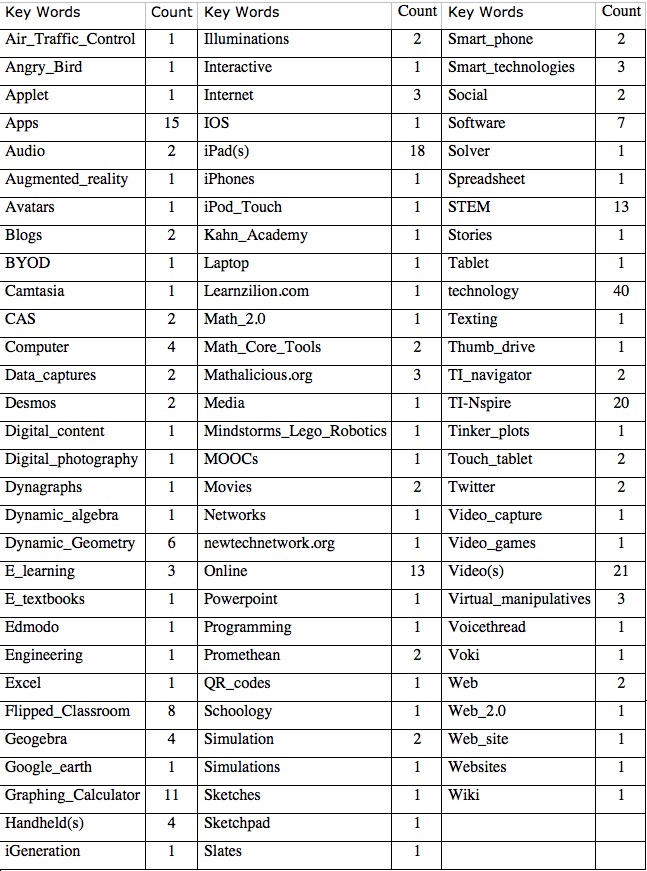
Top 10 Key Words @ NCTM 2014 (to see count of all
key words, click on image above.)
Welcome to my annual technology preview of the NCTM conference in New Orleans next April. There are 653 sessions of all shapes, sizes and themes. I read them all and again as in previous years I highlight a subset of sessions that have the technology principle (TP) in mind. Supporting that principle has been CLIME’s goal since TP's introduction in "Principles and Standards for School Mathematics" in 2000. More recently a new bolder theme has emerged to be CLIME’s focus something that I refer to as Math 2.0. I realize that it is not something easily defined though I keep on trying to capture its essence. My working definition of Math 2.0 is:
The New Orleans conference program committee designated several strands but only one had a technology theme: “Teachers leveraging Technology.”

At first glance I was surprised there were only 5 sessions, but what a treat these sessions appear to be! I plan to attend 4 of them skipping only Karim’s because that happens at the same time as my session. They all take place on Friday. Here’s a rundown of the sessions.

309
Math Teachers and Social Media: Professional Collaboration or Support Group?
Raymond Johnson
Jasperwood (Hilton)
8:00 AM-9:00 AM

335
Video Games and Making Math More like Things Student Like
Dan Meyer
Great Hall A/D (Convention Center)
9:30 AM-10:30 AM

402
Keeping It Real: Teaching Math through Real-World Topics
Karim K. Ani
Great Hall B/C (Convention Center)
11:00 AM-12:00 PM

465
The Mathtwitterblogosphere: Creating Your Own Online Professional Learning Communities
Ashli J. Black and Chris Hunter
225/226/227 (Convention Center)
12:30 PM-1:30 PM

495
One of Us: Every Teacher a Blogging Teacher
Kate Nowak
Grade Band Audience: General Interest/All Audiences
2:00 PM-3:00 PM

I’m not exactly sure why mine was left off the list since I think leveraging (using something to maximum advantage) technology is a big part of what Math 2.0 is all about.

Each of the 5 sessions focuses on themes that are significant in a Math 2.0 classroom environment: Social media, video games, real world applications and blogging as a significant new form of professional development.

Of the 653 descriptions of sessions that I read (with this vision of Math 2.0 on my mind) 161 sessions have a technology theme.  That’s almost 21% which is down from a high of 38% at the Philly Annual Meeting in 2012 and 28% in Denver in 2013.

I’ve highlighted 16 that are on my "plan to attend" list. (This list includes my session #398 on Math 2.0 at the Hilton at 11am.)

If you would like to have your session highlighted let me know. I can also add a photo and additional links to your listing.

It’s been a long time since you submitted your proposal and you might want me to add some updates to your session listing on the CLIME conference technology site. Send me an email ihor@clime.org with the updates (your photo, links, etc.) and I will immediately post them to the website.

Monday, January 13, 2014

Noon Day Project Announcement

Here is a letter that will appear in a future AMTNJ (Association of Math Teacher of New Jersey) newsletter. I thought I would would post it here.

Dear Colleagues:

Twice a year I give a shout out to all that can hear about my favorite collaborative project called the Noonday Project hosted by Stevens Institute of Technology’s Center for Innovation in Engineering and Science Education (CIESE) which twice a year has students from around the world recreate measuring the circumference of the earth similar to what Eratosthenes did 2200 years ago. The measurements are done at the time of the Equinoxes approximately March 21 and September 21.

This year (2014) AMTNJ (Association of Mathematics Teachers of New Jersey) is celebrating its Centennial and will be collaborating with Greg Bartus at CIESE and the Council for Technology in Math Education (CLIME) an affiliate of NCTM to bring this wonderful project to you. It starts on March 10 and continues through April 11th 2014.

This will be followed by a videoconference hosted by Eric Vayssie which will be an opportunity for students from around the world to share their results from doing these measurements and participating in this project.

This is an exciting opportunity. I hope you can join us.

Here are some relevant websites for you to familiarize yourself with the project:

Noon Day Project, CIESE, Stevens Institute of Technology.
Link: http://ciese.org/curriculum/noonday

Videoconference - Eratosthenes: How Big is Our World? Eric Vayssie
Link: http://www.eratosthenes.eu/spip/

In the Spirit of Eratosthenes, Measuring the Circumference of the Earth, Ihor Charischak
Link: http://dmcpress.org/articles/SpiritEratArticle.ic.pdf

Sincerely yours,
Ihor

Ihor Charischak
President, CLIME
Council for Technology in Math Education
White Plains, NY 10606
ihor@clime.org

Thursday, November 14, 2013

Heart Warming Approaches to (Core?) Curriculum Reform

There’s a lot of discussion about the CCSSI (do I really have to write it out?) for math. Mostly its about the Standards and assessments which for me is a checklist for what I should include in a curriculum. But what about the curriculum? What does it look like in most schools? I would guess that the textbook companies are controlling that world and that’s very depressing, because I haven’t seen any textbooks that breaks the mould of what we have encountered before even if its been spruced up by the requirements of the Common Core standards. But if you look past the usual suspects, you will find in the blog world some innovative, heart warming approaches. Case in point, Geoff Krall. In his his initiatives. Geoff (My Common Core Problem Based Curriculum Maps) has crafted a game plan for proceeding with reinventing how math can be taught in schools. He has collected activities and projects from his math blogging colleagues and organized them into a curriculum. When I was still at Stevens/CIESE I did a similar approach with the 6th Everyday Math curriculum since the teachers in the Elizabeth, NJ school district wanted more technology based activities that were not part of EDM. This kind of work requires support from the teachers, pedagogical change coaches (like I was there) and administration support to work. Unfortunately, my effort in Elizabeth has sat dormant since I retired from CIESE in 2007.

What we need is a curriculum (a modern textbook, if you like) that is written from a student's perspective. Most textbooks are written so that adults reviewing the books will find all the required checkboxes checked before they adopt. Why can't textbooks be written as engaging stories that students would buy into? I suspect very few kids would choose the books that are currently coming out of the textbook mills if they had a choice. Engaging stories should drive curriculum. Then students would actually want to do the activities in the book instead of being force fed by the teachers because they are "good for you."

Geoff Krall to his credit has listed links to interesting stories, but they are still on the sidelines in the curriculum game. Some day it will happen. The current technology makes it possible and the math blogging community is putting examples out there every day. However, the devotion to the Royal Road to Calculus continues to interfere with student engagement and genuine learning.

Math Stories - Engaging students in thinking about mathematics

In June 2013 I wrote about the Jinx Puzzle where you pick a number and then do several different calculations to that number and the result is 13 no matter what number you started with. I called it the Jinx puzzle for that reason. Why does it work every time? The secret is in the algebra. See below.

1. Choose a number. Call it X
2. Add 11. Now you have X + 11
3. Multiply by 6. Result is: 6X + 66
4. Subtract 3. The result is:  6X - 63
5. Divide by 3. The result is:  2X + 21
6. Add 5. The result is: 2X + 26
7. Divide by 2. The result is: X + 13
8. Subtract the original number that you chose. The result is: X + 13 - X = 13

You are jinxed. Problem solved. Case closed. But what if we were teaching typical 6th graders then a more interesting twist on this story is to not assume the obvious (that it always works) and see whether these students could find a number that foils the Jinx Puzzle. Since testing numbers manually becomes quickly tedious a spreadsheet calculator can help with testing a wide range of numbers. There’s just one problem. If you use a spreadsheet you can get a result that actually foils the Jinx Puzzle! Try something like 3.0 x 10 to the 16th power as your number.

This is caused by the fact that the spreadsheet will round off numbers after a long string of numbers is entered or will send a bogus number because we have gone passed its capability to stay accurate.

Dan Meyer in a his 101 questions activity shows how Google Calc fails to handle a subtraction problem by printing 0 instead of the correct answer of 1 just because it doesn’t play well with very large numbers.

In an episode of The Simpson's called The Wizard of Evergreen Terrace, Homer appears to write a valid solution to defeat Fermat's Last Theorem which states that no three positive integers a, b, and c can satisfy the equation a^n + b^n = c^n for any integer value of n greater than two. But given that Fermat's last theorem is proven, is Homer's attempt a real counter example that Fermat and others didn't see? Look at the equation (above) that Homer used using the Desmos calculator to check his work. Looks like the real deal doesn't it?
Simon Singh who writes about this in his latest book "The Simpsons and their Mathematical Secrets" calls Homer’s attempt at a solution a near miss. If you use a calculator that’s good to 10 places like Desmos, it seems to work. But the devil is in longer approximations. It’s close, but no cigar. And we need exactitude to proof the theorem. Andrew Wiles who proved Fermat’s Theorem in 1995 has nothing to worry about from Homer Simpson.